

Who this is for, and what makes dental different
This is for people who own or run a dental practice in Orange County and want to understand what actually brings new patients in from the internet. Everything here you can do yourself. None of it is secret.
Three things make dental unlike other local trades, and they change the whole approach:
- Your patient is anxious before they ever search. Nobody looks forward to a dental appointment. They are not comparing features — they are looking for a reason to feel safe. Every part of your online presence either reduces that fear or adds to it.
- The search is planned, not urgent. Unlike a plumber or an HVAC company, most of your searches are not emergencies. People look, read reviews, look again, and book days later. That means your reviews and your site get read properly, which is good news if they are good and expensive if they are not.
- You are regulated. Patient photos need consent. Testimonials need care. That is a real constraint that most marketing advice ignores entirely.
The rest of this page is the system in order. Each section is short on purpose and points you to the detailed article where one exists — this page is the map, not the manual.
Are patients actually finding you? Four checks
Do these in an incognito window. Your own search history makes your practice look like it ranks better than it does.
-
Search "dentist" plus your city
Not your practice name. Search the way a stranger would: "dentist Huntington Beach", "dentist near me". Are you in the box of three with the map beside it? That box takes most of the clicks.
-
Search a procedure plus your city
"Invisalign Costa Mesa", "dental implants Newport Beach", "emergency dentist Fountain Valley". These convert far better than the general search, because the person already knows what they need.
-
Ask ChatGPT for a recommendation
"Who's a good dentist in Huntington Beach?" Ask twice, worded differently. Two blanks tells you something.
-
Open your own site on your phone
On cell data, not office wifi. Over three seconds and you are losing people — 53% of mobile visitors leave a page that takes longer than that. Then try to tap your phone number. If it does not dial, you are losing the easiest booking you will ever get.
The full five-test version covers the general checks including whether Google has indexed your site at all.
Your Google Business Profile: the category most practices get wrong
Your profile does more for a dental practice than the website does. It is what puts you in the map pack, and it is free.
The single highest-leverage field is the primary category, and most practices pick it wrong. The instinct is to choose something broad. The correct move is the most specific category that matches what you actually want to be found for:
| If you are | Primary category | Not |
|---|---|---|
| A general family practice | Dentist | Health & Medical |
| Mostly cosmetic work | Cosmetic Dentist | Dentist |
| Orthodontics | Orthodontist | Dentist |
| Paediatric | Pediatric Dentist | Dentist |
Then add secondary categories for the rest: Cosmetic Dentist, Pediatric Dentist, Emergency Dental Service. Secondary categories are cheap to add and widen what you can appear for.
List each procedure as its own service entry — Invisalign, implants, whitening, veneers, crowns, root canal, emergency care — not one paragraph. Each entry is a separate thing Google can match a search to.
Seed the Q&A yourself. Most practice owners do not know you are allowed to ask and answer your own questions. The three worth adding on day one: do you take my insurance, do you see emergencies, and what is the new-patient offer.
The full chapter covers claiming, verification, recovering a hijacked listing, photos, and posts.
Reviews: what the number actually needs to be
84% of patients trust online reviews as much as a personal recommendation. For an anxious buyer choosing a dentist, reviews are not a ranking factor first — they are the reassurance that gets the call made.
What the numbers say for a competitive Orange County practice:
- Businesses with 50 or more reviews get roughly 4.4 times more clicks than those under five.
- The biggest single return comes from moving out of the 26–50 band into 51–100.
- 68% of consumers now require a 4-star minimum.
- Around 150 reviews is where AI assistants start naming a business in local recommendations.
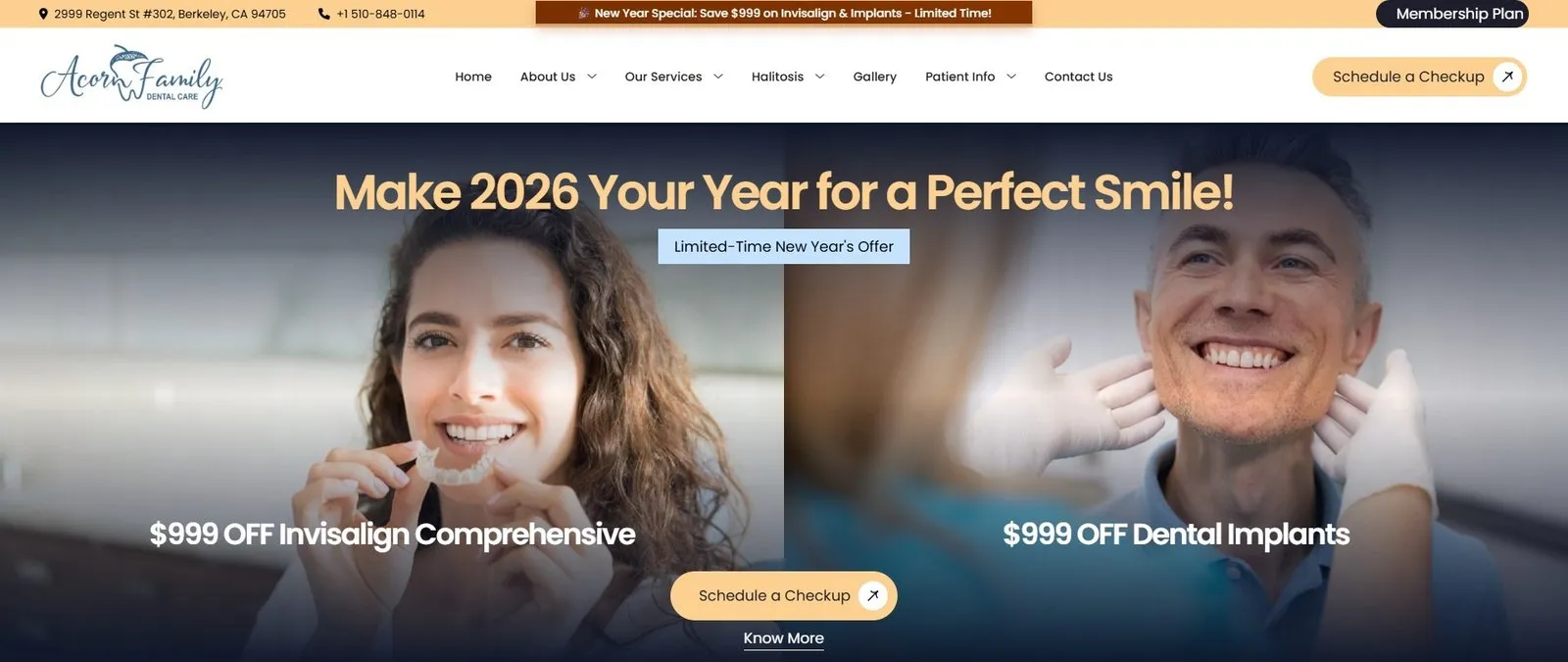
For context on what is achievable: HB Dentist in Huntington Beach grew to a 4.9-star rating with over 500 reviews, up from about 200. Acorn Family Dental Care passed 100 five-star reviews after rebranding.
The dental-specific part: ask at the end of the appointment, while the patient is relieved it is over and while they are still in the chair or at the desk. Not by email three days later. Then text the direct link the same afternoon. The relief is the moment, and it passes.
Two things to avoid: never ask only the patients you expect to be happy, and never buy reviews. Both violate Google policy and both are detectable.
The full reviews chapter has the scripts, the follow-up sequence, and the reply templates.
Your website: the four things a dental site cannot omit
You need the site even with a complete profile. The profile is rented from Google — they set the rules and can suspend it. The site is the only asset you own, and it is what AI assistants cite.
Four things a dental practice website must have, in priority order:
- Online booking that works on a phone. The anxious patient who finally decided to book at 10pm will not call you in the morning. Acorn Family Dental Care added online booking and it cut front-desk call volume as a side effect.
- Insurance and financing, stated plainly. "Do you take my insurance" is the most common unasked question. Answer it on a page, not only on the phone.
- A page per procedure. Invisalign, implants, whitening, veneers, emergency. One combined "services" page ranks for none of them. HB Dentist got page-one rankings for 12+ competitive dental keywords this way.
- Speed on a phone. Under three seconds. HB Dentist went from a 2.8-second WordPress site to sub-2-second load times as part of a rebuild.
What matters less than people think: the stock photo of a model with perfect teeth, the hero video, and the "welcome to our practice" paragraph nobody reads.
On before-and-after galleries: they convert extremely well for cosmetic work, and they need written patient consent. That is not optional and it is not a formality.
The website mistakes post covers what 50+ Orange County practice audits actually found. The general website chapter covers Core Web Vitals in plain English.
AI search: what patients are asking assistants
A growing share of people skip Google and ask ChatGPT, Perplexity or Gemini for a recommendation. If the assistant does not know your practice exists, you were never in that conversation.
The prompts patients actually use are not the searches they type. They are longer and more personal:
- "Who's a good dentist in Huntington Beach that takes Delta Dental?"
- "I'm nervous about the dentist — who's gentle with anxious patients in Orange County?"
- "Best Invisalign provider near Costa Mesa?"
- "I need an emergency dentist right now in Fountain Valley"
Notice what those have in common: insurance, anxiety, a specific procedure, urgency. If your site answers those in plain sentences that name the practice, the city and the fact, an assistant can lift the answer. If the information only exists in a PDF or on the phone, it cannot.
The mechanics are the same as the general chapter — consistent business details everywhere, direct answers on your own pages, schema markup, enough independent corroboration to make naming you a safe bet. The AI search chapter covers the full method, including checking your robots.txt is not blocking AI crawlers.
How OC clinics win the AI answer box is the dental-specific treatment.
Your first 90 days, sequenced for a practice
Free, and do it yourself
- Claim your Google Business Profile and set the primary category correctly — the specific one, not the broad one.
- Add every procedure as its own service entry.
- Seed three Q&A entries: insurance, emergencies, new-patient offer.
- Ask your next ten patients for a review, at the desk, then text the link the same day.
Why first: profile signals are roughly 32% of local ranking weight and reviews another 16%. Both are free.
Fix what patients land on
- Open your site on your phone on cell data. Fix whatever fails.
- Make the phone number tappable and put online booking above the fold.
- Put insurance and financing on their own page.
- Rewrite one procedure page properly — start with your highest-value treatment.
Why second: the profile sends people somewhere. Make the somewhere work before you send more.
Build
- A page for each remaining procedure you want to be found for.
- Push past 50 reviews, then keep the pace steady rather than bursting.
- Add Dentist and LocalBusiness schema to the site.
- Check AI crawlers are not blocked in robots.txt.
Measure
- Re-run the four checks. Write the results next to your first attempt.
- Count new patient calls and online bookings, not rankings.
- Ask new patients how they found you. The answer is often not what the analytics say.
What to expect, honestly. Traffic tends to move in 30 to 60 days. Map pack movement takes 60 to 90. Patient inquiries usually follow by month three. Anyone promising page one in 30 days is selling something.
How OC dentists reach the top of Google Maps in 90 days covers the Maps work in detail.
What it costs, and how to judge a quote
Pricing is not trade-specific, so this page does not repeat it. Two things worth knowing before you talk to anybody:
- The average agency retainer across the industry is about $3,209 a month. Local SEO for a small practice typically runs $500 to $1,500 for a narrow scope.
- Below roughly $500 a month, do the free work yourself first. Profile and reviews return more than a small retainer buys.
The marketing cost calculator works out the number for your situation from four questions. Dental SEO costs in Orange County has the trade-specific breakdown, and the chapter on hiring an agency has the five questions to ask — they work on us too.
Orrku Media runs local SEO for dental practices in Huntington Beach, CA, and grew HB Dentist from page five to a 156% organic traffic increase with double the monthly patient inquiries.
Serving Huntington Beach, Costa Mesa, Newport Beach and surrounding areas. Local SEO in Huntington Beach, CA · Talk to Ram
Social media: the honest verdict for dental
Some. Not the enthusiastic yes a social agency will give you, and not a no.
41% of people say social media influences their choice of dentist, which is real. But search drives the actual bookings. The distinction matters: social builds the trust that makes someone pick you once they have found you. It rarely finds them in the first place.
What that means practically:
Social media tips for dentists has the detail. The general chapter has the per-trade comparison.