
The numbers, so you know what you are aiming at
Reviews do two jobs at once: they push you up the map pack, and they decide who gets the call once you are there. Both matter, and the second one is the reason a business can rank third and still win.
What the 2026 data says:
- Review signals are roughly 16% of local pack ranking weight.
- Businesses with 50 or more reviews get about 4.4 times more clicks than those under five.
- The biggest jump in return comes from crossing out of the 26–50 band into 51–100.
- 68% of consumers now require a 4-star minimum before they will consider you — up 13 points from 2025.
- Expect roughly a 3% lift in profile conversions per 10 new reviews.
- 87% of consumers read reviews for local businesses; 73% say positive ones make them trust a business more.
- Around 150 reviews per location appears to be where AI assistants start naming a business in recommendations.
That last figure is the one almost nobody is discussing yet. Reviews now feed AI answers as well as Google rankings, which quietly doubles the value of every one you collect.
Velocity beats total
This is the part owners get wrong, so it goes first.
Forty reviews earned steadily beats sixty earned in one week.
Google weighs recency. A business with a review from this week looks open, busy and current. A business with ninety reviews whose newest is from 2024 looks like it might have closed.
A sudden burst also looks bought, because usually it is. Ten reviews appearing on a Tuesday after eighteen months of silence is a pattern Google's systems are specifically built to notice.
The target that actually works: two to four new reviews every month, forever. That is one a week at most. It is a boring target and it beats every clever alternative.
Remove the friction first
The main reason businesses do not get reviews is not reluctance. It is friction.
If a customer has to remember your exact business name, search it, find the reviews section, and work out where to write — most will abandon it, and they were willing. Your job is to delete every step between "I'd be happy to" and a submitted review.
Get your direct review link
Google gives you a shortcut URL that opens the review box directly.
- Open your Google Business Profile dashboard.
- Find "Ask for reviews" or "Get more reviews".
- Copy the link.
- Shorten it if you will be reading it aloud or printing it.
One tap and they are typing. No searching, no navigating.
Then put a QR code on things
Turn that link into a QR code and print it on whatever your customer is already holding:
- The counter or reception desk
- Your invoice or receipt
- Business cards
- Job completion paperwork, for trades
- Appointment reminder cards, for practices
- The bottom of your follow-up email
QR codes work because they convert "I should do that later" into something done on the spot. Later never arrives.
When to ask
Timing does more work than wording.
| Ask | Do not ask |
|---|---|
| Right after they compliment your work | Mid-job, while they are thinking about something else |
| At the final walk-through, seeing the finished result | Weeks later, once they have mentally moved on |
| At the front desk after a good appointment | While anything is unresolved — fix it first |
| By text 24–48 hours later, while it is fresh | Repeatedly, to the same person |
The single best moment is the one where the customer says something nice to you unprompted. That is your cue. Everything else is a fallback.
How to ask without feeling like a salesman
This is where most owners freeze. It feels awkward or needy. It does not have to be either, because you are not asking for a favour — you are telling somebody who is already pleased that there is a two-minute way to help.
In person
Glad you're happy with it. If you have a minute, a Google review really helps other people in Huntington Beach find us — I can text you the direct link so it's quick.
That is the whole script. No pressure, no pitch. Then actually send the text while you are standing there.
By email, 24–48 hours later
Subject: Quick favour?
Hi [Name], thanks for choosing us for [the job]. Hope you're pleased with how it turned out. If you have 30 seconds, a Google review would mean a lot — it's how most local homeowners find us.
[Leave a review →]
Thanks again.
Short. Personal. One link. No corporate throat-clearing.
By text
Hi [Name], thanks again for choosing us. If you had a good experience, a quick Google review would really help: [link]
Text open rates run around 98% against roughly 20% for email, which makes this the highest-yield channel you have — provided the customer has agreed to be texted.
Build the system, not the burst
Businesses with hundreds of reviews are not more charming than you. They have a system that runs whether anyone remembers or not.
Five parts:
- Pick the trigger. Which single event in your process means the job is done? Final walk-through, appointment checkout, delivery, install sign-off.
- Name who asks. A person, not "the team". The project manager. The receptionist. The technician who did the work.
- Automate the follow-up. One text or email, 24–48 hours after the trigger, with the direct link.
- Track the count monthly. Two to four a month is the target. If you missed it, the trigger or the asker is the usual culprit.
- Reply to every review within 48 hours.
What this looks like when it works
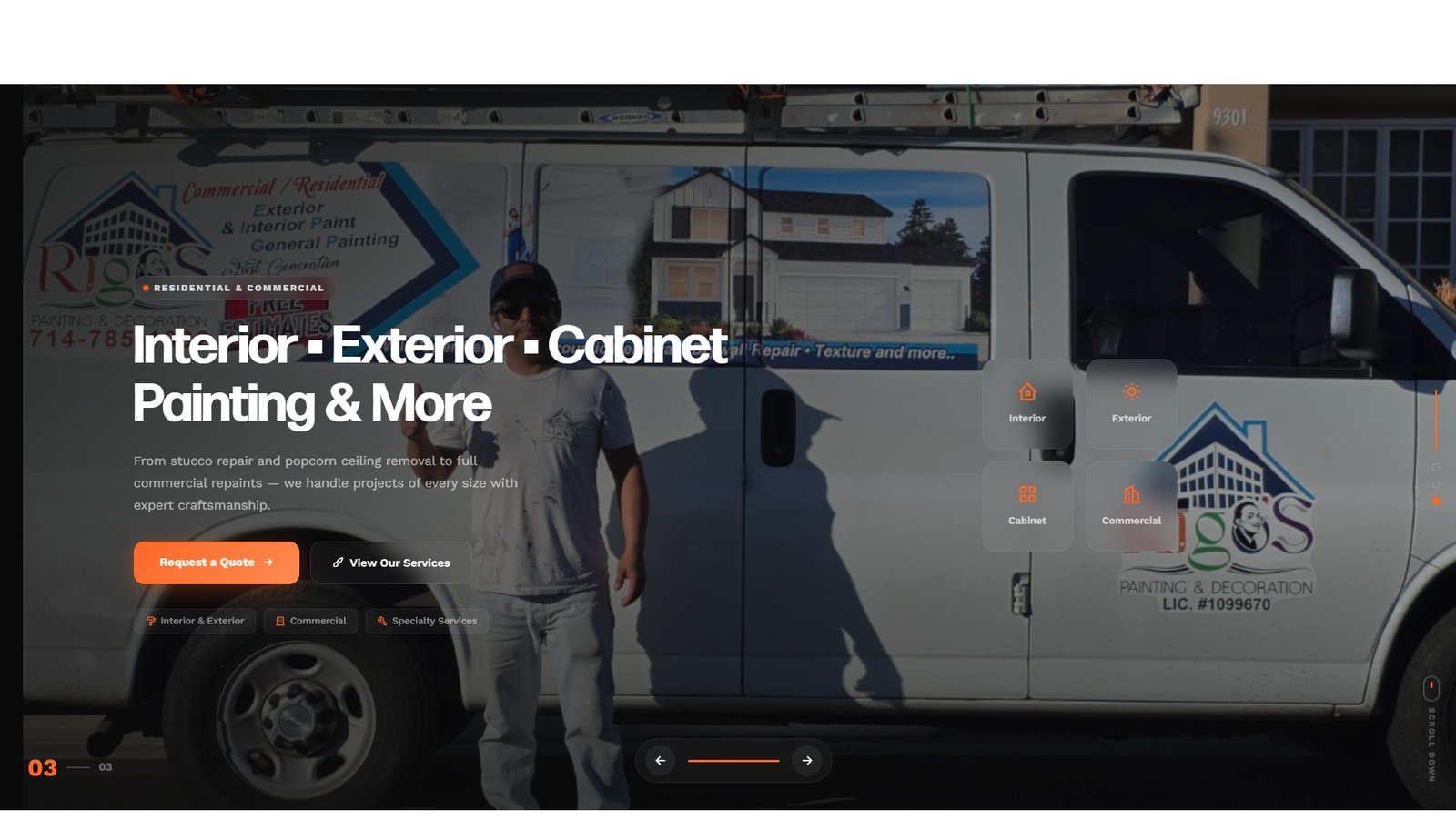
Rigo's Painting, an Orrku Media client, has built over 1,000 Google reviews — among the highest of any painting contractor in Orange County. The system is unglamorous:
- The project manager asks during the final walk-through, when the customer is looking at the finished work.
- They hand over a card with a QR code straight to the review page.
- A follow-up text goes out 24 hours later.
- The owner personally replies to every single review.
No incentive, no trick, no software. Four reviews a week becomes 200 a year, and 200 a year becomes an advantage nobody can buy their way past quickly.
Replying to reviews, including the bad ones
Collecting reviews is half of it. Replying is the half most businesses skip, and it is visible to every future customer reading the page.
Good reviews
Do not reply "Thanks!" eleven times in a row. Use their name, name the actual job, invite them back. Naming the job also puts real service-and-place words on your profile, which does quiet SEO work.
Thank you, Sarah. We loved working on your kitchen and we're really glad it came out the way you pictured it. It was good getting to know the family — shout if you need anything down the line.
Bad reviews
Four steps, in order:
- Acknowledge. "Thank you for the feedback."
- Apologise for the experience, without conceding facts you dispute.
- Move it offline. Give a phone number.
- Stay level. Never argue, never blame the customer in public.
Sorry to hear this did not go the way it should have. We take that seriously and would like to put it right — could you call us on (714) 732-8549 so we can go through it properly?
Here is the thing worth internalising: prospective customers read the one-star reviews on purpose, and they read your reply more carefully than the complaint. A calm, human response to a harsh review earns you more trust than three more five-star reviews would.
Never put private customer details in a public reply. In healthcare that is a legal problem, not just poor form.
Fake reviews
You cannot delete a review yourself. You can report it: open the review, click the three dots, choose "Report review." Google assesses it against their policies, which takes days to weeks and does not always go your way. Reply professionally in the meantime so readers see your side.
What Google actually forbids
Four practices that look like shortcuts and are genuinely risky:
- Incentives. No discounts, gifts, free coffee or prize draws in exchange for reviews. Google's policies prohibit it outright. You may ask for a review; you may not pay for one, in cash or in kind.
- Buying reviews. Detection has got considerably better. Penalties range from silent removal of the reviews you paid for to suspension of the listing.
- Review gating. This is asking customers privately how it went, then only sending the happy ones to Google. It is against policy, it is detectable, and it is more common than people admit.
- Spamming the same customer. One ask, one follow-up. A third is an irritation that costs you the review and possibly the customer.
And one that is not forbidden but is self-defeating: ignoring negative reviews. Silence reads as indifference to everybody who scrolls past it.
Do this week
Five things, in order, none of which cost money:
- Get your direct review link out of your Google Business Profile.
- Turn it into a QR code and print it on something your customers already touch.
- Write your follow-up text and email once, so it exists and you never write it again.
- Ask your next five customers, in person, using the script above.
- Reply to every review you have not replied to. Yes, including the old ones.
Once the first few land, this becomes self-reinforcing — the count climbs, the ranking follows, and the ranking brings more customers to ask.
Orrku Media builds review generation systems for local service businesses across Orange County, including the process behind Rigo's Painting's 1,000-plus Google reviews.
Serving Huntington Beach, Costa Mesa, Newport Beach and surrounding areas. Local SEO in Huntington Beach, CA · Talk to Ram